
Blogging
Who Really Writes Best? Ranking 10 Cebu Bloggers by Writing Quality – Not Followers, Awards or Clout
The word “blogger” has changed.
Once, it meant someone who sat down, opened a blank page, and actually wrote. Today, the label is often stretched to include influencers, vloggers, TikTok creators, Facebook personalities, Instagram creators and practically anyone with an audience online.
There is nothing wrong with those forms of content. But they are different crafts.
So I wanted to ask a more uncomfortable question:
If we remove follower counts, awards, popularity, brand partnerships, SEO rankings and years in the industry, who among Cebu’s established bloggers can actually write?
Not who gets invited to the most events.
Not who has the biggest social-media following.
Not even who is the most famous.
I mean “writing”: the ability to hold a reader’s attention for 1,000 words or more, develop an idea, tell a story, build an argument, observe something others might miss and leave the reader thinking differently when the article ends.
That produces a very different ranking of the best Cebu bloggers.
Related post: Blogging vs Vlogging: Blogging Is Still the Top Choice Over Vlogging in 2022
First, how I ranked the bloggers
This is not a popularity contest, and it is certainly not a scientific measurement of literary ability. It is an editorial assessment based primarily on representative long-form work, with particular attention to recent writing from 2025 to 2026.
More importantly, several things deliberately do not count here: followers, website traffic, social engagement, blogging awards, influencer status, years of blogging, brand partnerships and general digital authority.
Someone could therefore be a bigger or more successful blogger overall and still rank below someone else on this list.
I used five criteria:
| Criterion | Weight | What I looked for |
|---|---|---|
| Prose and distinctive voice | 30% | Does the writer have a recognizable voice? Is the writing clear, natural and compelling? |
| Depth and originality of thought | 25% | Does the article go beyond surface information and say something worth thinking about? |
| Structure and development | 20% | Can the writer sustain an argument or story instead of producing disconnected paragraphs? |
| Research and observation | 15% | Is there evidence of reporting, research, firsthand insight or close observation? |
| Long-form substance | 10% | Does the article justify its length, or is it merely an SEO page stretched to look substantial? |
And because I am included in this ranking myself, there is an obvious conflict of interest worth acknowledging. I am therefore applying the same criticism to my own work, including explaining why I did not rank myself first.
With that out of the way, here is my ranking.
10. Janine Ella Anongos: Off-Duty Mama
Writing score: 67/100

Janine writes with an easy, conversational personality. Her work often feels like someone genuinely recounting a trip, family experience or discovery rather than writing polished corporate copy.
That authenticity matters. In travel diaries, she is willing to admit disappointment, explain what she would do differently and document the small realities that don’t always make it into destination marketing.
Her limitation under this particular ranking is not readability. It is depth.
Many recent articles function more like personal travel journals or useful lifestyle entries than sustained long-form essays. The writing communicates experience effectively, but it does not consistently push that experience into a larger idea or narrative.
Off-Duty Mama itself describes the blog as a space for Janine’s motherhood, travel, food, beauty and lifestyle experiences, and that personal orientation remains its strength.
She is a good blogger.
This ranking simply asks a narrower question: Who is doing the strongest long-form writing?
9. Marco Yambao: Chibugan Kini
Writing score: 71/100

Marco’s strongest skill is description.
Food blogging requires making something sensory understandable through words, and Chibugan Kini frequently succeeds at describing dishes, restaurants, launches and consumer experiences in an approachable way.
The site also remains genuinely active as a written blog in 2026, covering Cebu restaurants, technology, travel and lifestyle rather than existing merely as an archive behind a social-media account.
Where Marco can grow as a writer is in moving from description into criticism and interpretation.
A restaurant article becomes considerably more memorable when the writer doesn’t merely tell us what tastes good but asks why a concept works, what fails, how the restaurant compares with Cebu’s changing dining scene, or whether the experience justifies its price.
Likewise, a technology preview becomes more distinctive when the writer moves beyond features into an independent argument.
Marco already has volume and experience.
The next step is stronger editorial judgment.
8. Sinjin Pineda: Adto Ta Philippines
Writing score: 75/100
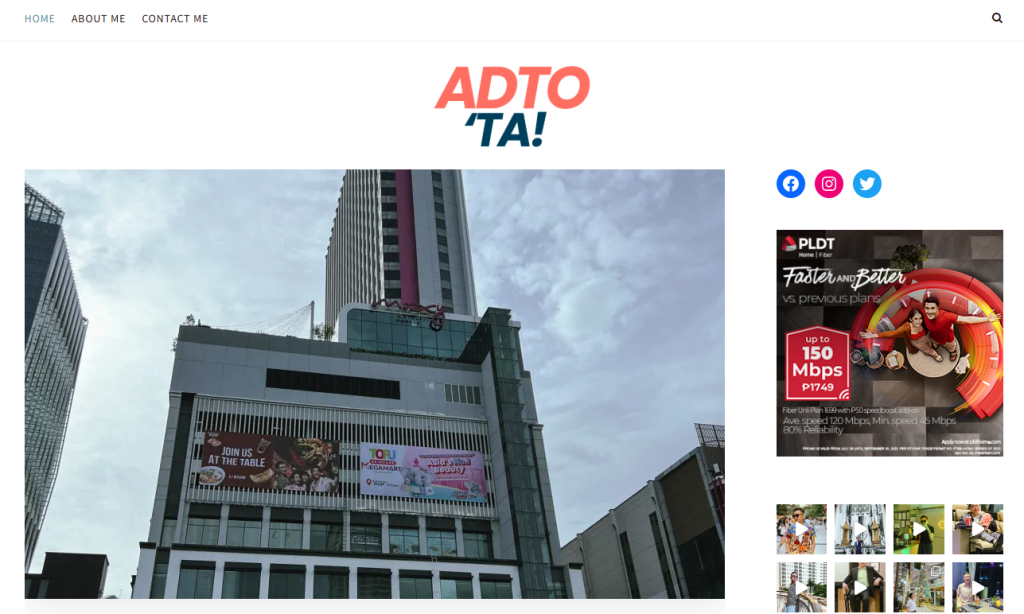
Sinjin Pineda is one of Cebu’s most recognizable traditional bloggers, and his site remains impressively active. In 2026 alone, his written output has included hotel reviews, personal-finance-adjacent lifestyle pieces, travel stories, technology and business coverage.
His strength is professional readability.
He understands headings. He knows how to move a reader through a hotel review. He knows which practical details travelers are likely to need. His writing rarely becomes difficult to follow.
But ironically, his experience as a successful commercial blogger sometimes works against him under this ranking.
Some articles begin with potentially interesting personal premises, only to transition into branded or product-driven sections. That is perfectly legitimate professional blogging. Brands pay bloggers precisely because they can tell stories around products.
But commercial objectives can interrupt the organic development of an essay.
Sinjin remains one of Cebu’s strongest all-around bloggers.
Purely as long-form writing, however, I think there are writers above him who take more intellectual or narrative risks.
7. Margaux Camaya: The Visual Traveler
Writing score: 77/100

Margaux may have the most intellectually curious blog in this entire ranking.
Look at her recent subjects: Philippine numismatics, Spanish friars and cattle ranches, books, art, the National Museum, Chinese lions at the Cebu Metropolitan Cathedral, tombstones in Intramuros, food and cultural history. Her 2026 archive shows an unusual willingness to explore subjects most lifestyle bloggers would never touch.
That earns considerable points for originality.
The Visual Traveler often makes me think: there is a fascinating essay hiding here.
The problem is that some pieces end before that essay fully develops.
Margaux sometimes discovers a rich historical question, gives readers an intriguing introduction and provides context, but stops just as the subject starts opening into something bigger.
Interestingly, some of her more personal writing demonstrates that she is perfectly capable of reflection. An earlier essay about journaling, for example, develops into an examination of private versus public writing and the fear of confronting one’s own truth.
She has ideas.
I’d simply like to see more of them allowed to grow into 1,500- or 2,000-word essays.
6. Leylan Romarate: My Cebu Photo Blog
Writing score: 80/100

Leylan has something difficult to manufacture: a genuine sense of Cebu.
My Cebu Photo Blog remains active in 2026, documenting places such as Medellin, heritage attractions, communities and spaces around Metro Cebu.
His writing doesn’t usually arrive with grand declarations. Instead, he notices things.
A drive north.
A familiar road.
A place that thousands of Cebuanos pass without really seeing.
A changing neighborhood.
A small roadside stop.
That restraint can make his work feel surprisingly human.
But the very identity of My Cebu Photo Blog explains why Leylan lands in the middle of this ranking rather than near the top.
His photographs frequently carry an enormous share of the storytelling. The prose accompanies the visual documentation rather than always functioning as a fully independent long-form narrative.
If this were a ranking of who has documented Cebu most meaningfully through blogging, Leylan could easily challenge for the top positions.
But this is specifically a writing ranking. And that changes the result.
5. Erica Jahn: The Girl with the Muji Hat
Writing score: 83/100

Erica represents a completely different kind of long-form excellence.
She isn’t #5 because she writes literary essays.
She ranks this high because she understands how to build an enormously useful article.
Her updated 2026 guide to Mactan resort day-use packages is a strong example. It doesn’t stop at naming resorts. It breaks down rates, inclusions, ideal audiences, personal recommendations, practical considerations and comparisons that actually help someone make a decision.
That is substantive blogging.
We sometimes romanticize writing so much that we forget one of the original strengths of blogs:
A stranger searches Google because they have a problem. They read your article. They leave knowing what to do.
Erica does that exceptionally well.
The trade-off is that highly structured utility content can feel more like a definitive guide than an essay. Tables, repeated practical information and search-oriented organization sometimes take precedence over voice.
But useful writing is still good writing.
And among Cebu bloggers producing practical long-form resources, Erica deserves considerable credit.
Related post: Top 10 Cebu Bloggers and Influencers Based on Influence.co
4. Jullian Robin Sibi: Utterly Techie
Writing score: 86/100

Jullian does something many technology bloggers struggle to do: He has opinions about technology rather than simply repeating specifications.
Utterly Techie publishes a tremendous volume of gadget news and reviews, but the writing becomes much more interesting when Jullian leaves product announcements behind and starts arguing.
His essay “Artificial Intelligence Excited Me. Now? ‘AI’ is a Marketing Term.” is a good example. Instead of jumping aboard the AI hype cycle, he argues that artificial intelligence has become an overused marketing label and contextualizes today’s claims against technologies that existed long before generative AI became fashionable.
His opinion archive also tackles foldables, Apple Silicon and the consequences of technology-industry changes rather than limiting itself to press releases.
That subject expertise gives him an advantage.
Jullian doesn’t need to pretend expertise after receiving a media kit. He has enough familiarity with technology to know when something is genuinely new, when something is incremental and when marketing language deserves skepticism.
He may not have the literary voice of the top three.
But as an analytical specialist writer, he is arguably the strongest Cebu blogger on this list.
3. Johanna Marie Frejoles: Bean in Transit
Writing score: 90/100
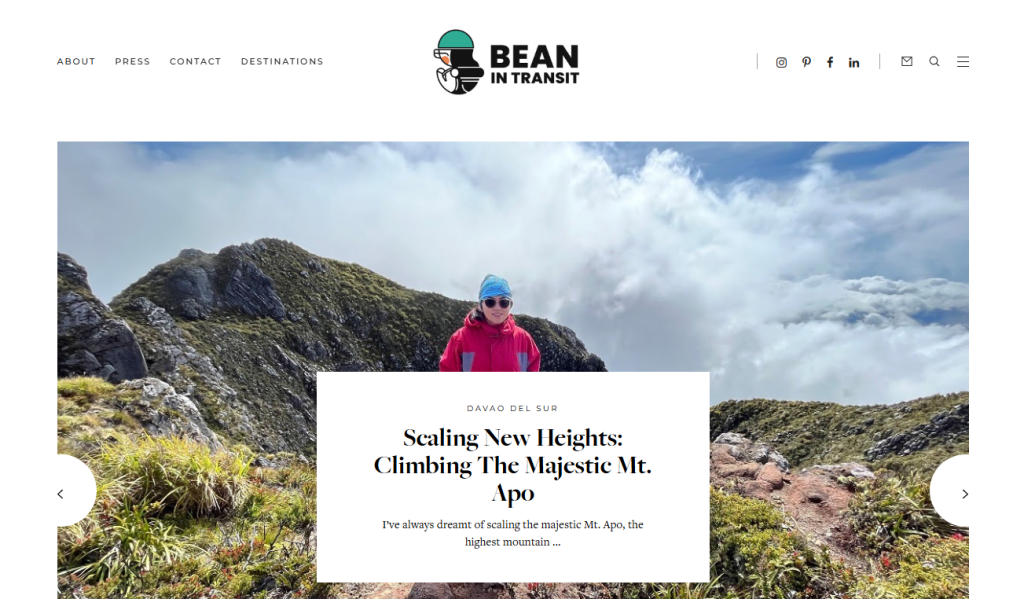
Johanna’s strongest writing does something I wish more advocacy writers understood: It allows the writer to be wrong first.
Her 2026 article explaining why she no longer recommends Oslob whale-shark watching begins with her own participation in the activity thirteen years earlier. She doesn’t pretend she always knew better. She admits that she didn’t understand the implications and didn’t ask enough questions at the time.
That immediately changes the tone.
Instead of lecturing readers from a position of moral superiority, she takes them through the process of reconsidering something she once experienced herself.
She then combines personal experience with environmental arguments, tourism practices and research.
That is persuasive writing because the writer isn’t simply trying to win. She is trying to understand.
Bean in Transit also demonstrates a strong travel-writing instinct: travel is not merely a list of destinations but a way of seeing places differently. Even an older account of flying over Cebu in a gyrocopter ends by reflecting on how altitude changed her perspective of a familiar place.
What keeps Johanna from #1 is consistency. Not every article in the archive reaches this level of depth.
But when she does long-form seriously, she is among Cebu’s best.
2. JP Abecilla: The Millennial Writer
Writing score: 92/100

Yes, I am ranking myself.
And no, I am not ranking myself first.
My strongest advantage today is that I am moving increasingly away from conventional lifestyle blogging and toward essayistic social commentary.
My article “Middle Class on Paper, Fragile in Reality” begins with a seemingly simple question: if somebody earns ₱80,000 a month, are they comfortably middle class?
The article eventually moves through income classifications, Filipino family obligations, healthcare spending, financial resilience and public policy, but continuously brings those abstractions back into recognizable everyday life.
A statistic about out-of-pocket healthcare becomes a Filipino family checking PhilHealth, calling a sibling, looking at a credit-card limit and wondering how much the hospital bill will become.
A debate about salary becomes a question of how many people depend on that salary.
That is the territory where I believe my writing is strongest.
Not simply what happened, but what does this say about us?
My current blog also increasingly spans marketing, career, politics, religion, social class and personal growth rather than remaining within a single lifestyle niche.
But there is also a weakness in my writing that I have to acknowledge.
I sometimes explain an idea after I have already successfully shown it.
I like rhetorical contrasts. I like parallel sentences. I like turning an argument into a memorable final line.
Those devices work, but any technique becomes predictable when used too often.
The improvement I need isn’t more complicated vocabulary.
It is greater restraint.
Trust the scene.
Trust the argument.
And sometimes trust the reader enough not to explain the meaning one final time.
1. Aldrich Infantado: The Bisaya Traveler
Writing score: 94/100

If I judge only the writing, I think Aldrich Infantado is currently the strongest storyteller among these Cebu bloggers.
The reason is surprisingly simple. He understands that the destination is not necessarily the story.
His 2026 archive contains what could easily have become ordinary travel content: NUSTAR Skydeck, Oslob paragliding, Batad, Mt. Tenglawan, Mt. Tuwato.
Instead, he repeatedly turns physical journeys into stories about ageing, mortality, fear, regret, rediscovery and the limited amount of time we have.
His Oslob paragliding article opens with the idea that Google Maps says the journey takes a few hours, but for him it effectively took seven years.
That isn’t travel information. That’s a story.
His Mt. Tenglawan piece begins with the provocative idea that someone dies whenever he climbs a mountain, the person who dies being an earlier version of himself. His NUSTAR Skydeck story takes a place associated with casinos and luxury and turns it into a meditation on curiosity and rediscovering Cebu.
Aldrich’s prose is not flawless.
It occasionally becomes excessive. Some metaphors announce themselves too loudly. Certain articles would benefit from tighter editing.
But editing can fix excess.
It is much harder to teach someone narrative instinct.
Aldrich understands beginnings.
He understands callbacks.
He understands tension.
And most importantly, he understands that readers don’t stay because they want another photo of a mountain.
They stay because they want to know what happened to the person climbing it.
That is why he takes #1.
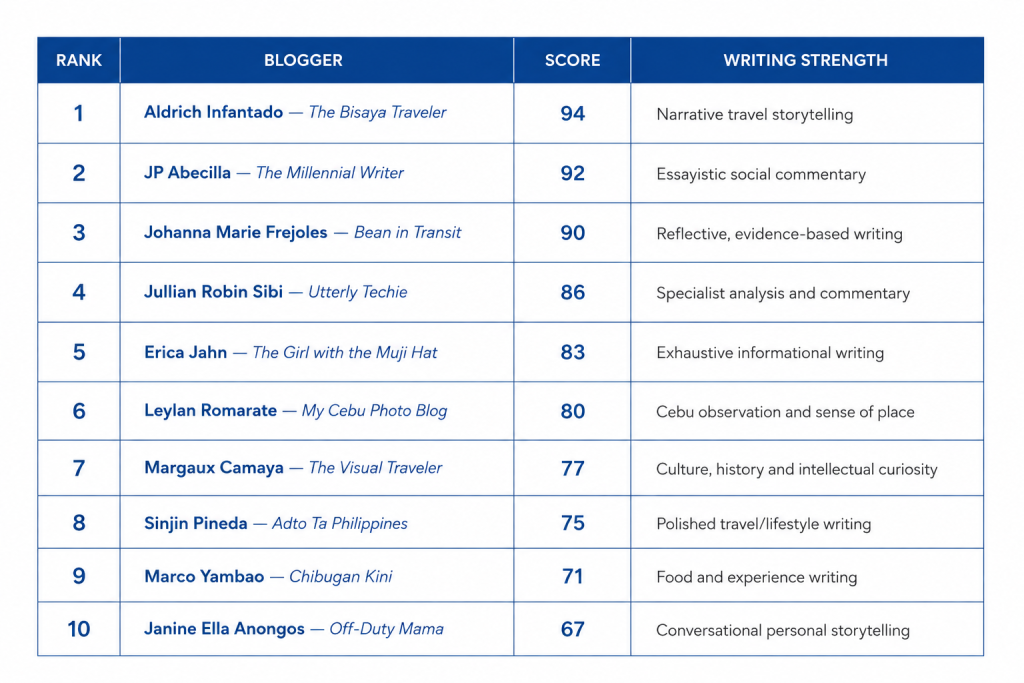
So, who are Cebu’s best writers in blogging?
The final ranking looks like this:
Blogging isn’t dead. Bad blogging is just easier to ignore.
Perhaps that is the bigger point.
People often say blogging is dying because TikTok, YouTube, Facebook and Instagram have shortened our attention spans.
I don’t completely believe that.
People still read long articles when the article gives them something they cannot get from a 30-second reel.
They read when someone teaches them something.
They read when someone makes them feel something.
They read when an argument challenges what they assumed.
They read when the writer tells a story so well that scrolling away feels like leaving a movie halfway through.
The real threat to blogging isn’t video.
It is forgettable writing.
A restaurant press release converted into a blog post is forgettable.
A travel itinerary copied from information already available elsewhere is forgettable.
A 2,000-word article written only to satisfy Google is forgettable.
But a Cebuano writer climbing a mountain and confronting mortality?
A traveler reconsidering an experience she once promoted?
A technology writer questioning an industry’s favourite buzzword?
A Filipino writer asking whether ₱80,000 really means security when an entire family depends on it?
Those are stories people can remember.
And perhaps that should be the standard when we talk about the best Cebu bloggers.
Not simply:
How many people follow you?
But:
When people finally stop scrolling and start reading, do you have something worth saying?
Related post: 6 Types of Bloggers You Need to Work With