
Philippine Politics
Top 5 Worst Presidents in Philippine History: Why Duterte Belongs Near the Bottom
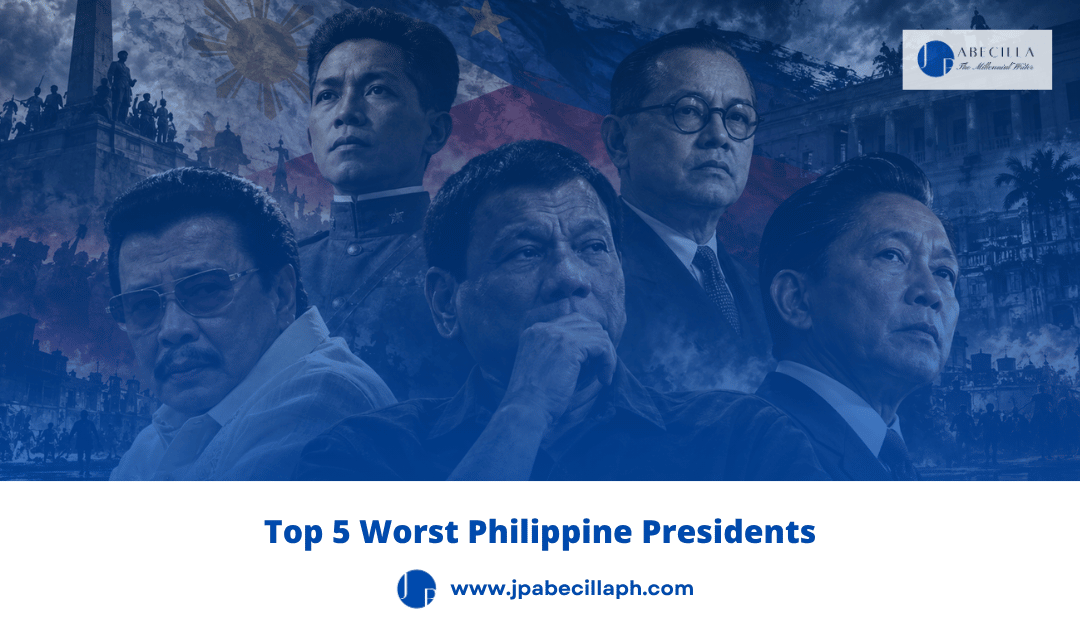
DDS supporters love to post on social media that Rodrigo Duterte is the best president in Philippine history. But most of the time, they do not prove it with serious standards. Their usual evidence is emotional: “I felt safe during Duterte’s time,” “drug addicts were afraid,” or “prices were cheaper before than today.”
That is not enough.
Feeling safe is subjective. Prices also cannot be compared only by memory, because inflation naturally reduces the purchasing power of money over time; the Philippine Statistics Authority defines inflation in terms of changes in the Consumer Price Index and declining purchasing power.
A fair presidential ranking should not be based only on popularity, slogans, fear, or visible projects. It should consider governance, rule of law, corruption, human rights, democratic damage, economic management, national unity, and long-term institutional legacy. The World Bank’s Worldwide Governance Indicators measure governance through areas such as voice and accountability, government effectiveness, rule of law, and control of corruption, while Freedom House evaluates political rights, civil liberties, rule of law, and personal freedoms.
Using that standard, my bottom five are:
5. Joseph Estrada
4. Emilio Aguinaldo
3. Jose P. Laurel
2. Rodrigo Duterte
1. Ferdinand Marcos Sr.
This does not mean these presidents had zero accomplishments. It means their failures, controversies, or historical damage outweighed their positive contributions.
5. Joseph Estrada: Populist Promise Destroyed by Corruption
Joseph Estrada entered Malacañang with massive popularity and a pro-poor image. But his presidency quickly became one of the most damaging post-EDSA administrations because of corruption allegations, political instability, and eventual removal from office.
His impeachment trial collapsed during the EDSA II crisis, and the Supreme Court later described the situation as one where Estrada had lost the support of the military, police, many cabinet members, and much of his political base.
The strongest fact against Estrada is not merely political opinion: the Sandiganbayan convicted him of plunder in 2007. The Supreme Court record states that Estrada was found guilty beyond reasonable doubt of plunder and sentenced to reclusion perpetua, though he was later pardoned by President Gloria Macapagal Arroyo.
Estrada deserves a place among the worst not because he had no mandate, but because he wasted one. His presidency weakened public trust, deepened elite corruption narratives, and became a symbol of how celebrity populism can collapse under the weight of governance failure.
4. Emilio Aguinaldo: Foundational but Deeply Divisive
Emilio Aguinaldo is historically important. He was central to the declaration of independence, the revolutionary government, and the First Philippine Republic. The National Commission for Culture and the Arts notes that Aguinaldo declared independence on June 12, 1898, raised the Philippine flag in Kawit, and organized a revolutionary government afterward.
But being historically important does not automatically mean being one of the best presidents.
Aguinaldo’s legacy is damaged by factionalism, internal revolutionary conflict, and the deaths of key Filipino revolutionary figures. The Philippine Veterans Affairs Office history material states that after hesitation, Aguinaldo confirmed the death sentence against Andres Bonifacio, who was executed in Maragondon on May 10, 1897.
The death of Antonio Luna also stains the revolutionary government. The National Historical Commission marker on Luna’s death place states that Luna and his aide Francisco Roman were assassinated in front of the presidential headquarters of the First Philippine Republic by members of Aguinaldo’s presidential guard.
Aguinaldo’s defenders may argue that he was leading under impossible revolutionary conditions. That is true. But his presidency also showed how personal rivalry, factional politics, and weak institutional discipline damaged the revolutionary cause from within.
He helped found the Republic, but he also presided over a deeply fractured revolutionary leadership. That is why he belongs near the bottom despite his historical importance.
3. Jose P. Laurel: President Under Occupation
Jose P. Laurel is one of the hardest presidents to judge. He was not simply a cartoon villain or ordinary traitor. Some historians argue he tried to protect Filipinos under brutal Japanese occupation. But in ranking presidents, legitimacy and sovereignty matter.
Laurel became president of the Japanese-sponsored Philippine Republic during World War II. Even a Philippine presidential proclamation later described him as president of the Japanese-sponsored Republic inaugurated in 1943.
The United States government at the time explicitly refused to recognize the Laurel government and called it a puppet government, stating that the only Philippine government it recognized was the Commonwealth government.
The Philippine Veterans Affairs Office history material likewise refers to the Second Philippine Republic as a “Puppet Government” established under Japanese occupation and headed by Laurel.
This does not mean Laurel had no personal courage or no redeeming qualities. But as president, his administration existed under foreign occupation and lacked genuine democratic legitimacy. A presidency under enemy sponsorship cannot rank highly in a list based on independent nation-building, democratic legitimacy, and sovereign governance.
Laurel’s tragedy is that he may have been trying to survive a terrible situation, but the office he held was structurally compromised from the beginning.
2. Rodrigo Duterte: Accomplishments Overwhelmed by Human Rights and Democratic Damage
Rodrigo Duterte is not the worst president in Philippine history. Ferdinand Marcos Sr. remains worse because dictatorship inflicted deeper and longer institutional damage. But Duterte is clearly among the worst.
To be fair, Duterte had accomplishments. His administration signed or implemented major laws and programs such as free tertiary education, universal health care, the Bangsamoro Organic Law, the Philippine Identification System, the Ease of Doing Business Act, TRAIN, expanded maternity leave, and infrastructure projects. Government and media summaries list these among his administration’s major policy achievements.
The Bangsamoro Organic Law was signed by Duterte in 2018, and the Universal Health Care Act became law under his presidency.
But the question is not whether Duterte accomplished anything.
The question is whether those accomplishments outweigh the damage.
They do not.
Duterte’s presidency is inseparable from the drug war. As of 2026, the International Criminal Court has confirmed charges against him for crimes against humanity and committed him to trial over alleged crimes committed in the context of the “war on drugs” between 2011 and 2019.
Duterte was arrested in 2025 and sent to The Hague, and that estimates of drug-war deaths range from more than 6,000 reported by Philippine police to as many as 30,000 claimed by human rights groups.
Reuters also reported that Duterte’s former police chief and ally Ronald “Bato” dela Rosa became the subject of an ICC arrest warrant for alleged crimes against humanity related to the drug war.
Duterte’s defenders say they “felt safe.” But safety for one group cannot erase the fear, grief, and unresolved deaths experienced by others. A presidency cannot be judged only by how safe loyal supporters felt. It must also be judged by whether the state respected due process, human dignity, and the rule of law.
His economic record also cannot be romanticized. The World Bank reported that the Philippine economy suffered severe contraction during the pandemic period, with the economy already posting a 10% contraction in the first three quarters of 2020, the worst since the 1985 debt crisis. Poverty also worsened during his term, with PSA reporting poverty incidence among Filipinos at 18.1% in 2021, higher than the 16.7% recorded in 2018.
Yes, the pandemic was a global crisis. But leadership is judged during crisis, not only during easy years.
Duterte also damaged public morality and democratic culture. He normalized violent rhetoric, contempt for human rights, vulgar public discourse, hostility toward critics, and the idea that accountability is automatically persecution. His supporters may point to roads, laws, and projects, but a good president does not only build structures. A good president strengthens institutions, public trust, civic morality, and respect for life.
That is why Duterte is not the best president.
He is one of the worst.
Not because he did nothing, but because the damage he left in human rights, democratic norms, public morality, and accountability outweighed his accomplishments.
1. Ferdinand Marcos Sr.: The Worst Overall
Ferdinand Marcos Sr. remains the worst Philippine president because his rule combined dictatorship, massive corruption, human rights abuses, crony capitalism, institutional destruction, and long-term economic damage.
Marcos had projects. That is true. But infrastructure does not excuse dictatorship.
Amnesty International states that Marcos’s martial law unleashed grave human rights violations, including tens of thousands of arbitrary arrests and detentions, as well as torture, disappearances, and killings. Amnesty also notes that the Human Rights Victims’ Claims Board received around 75,000 claims, with over 11,000 victims recognized after assessment.
The Presidential Commission on Good Government was created after Marcos’s fall specifically to recover ill-gotten wealth accumulated by Ferdinand Marcos, his family, relatives, subordinates, and close associates.
The economic record also destroys the myth of Marcos as a great builder-president. GMA News reported that Philippine foreign debt rose from $2.1 billion in 1970 to $12.7 billion by 1980, while crony capitalism placed key industries under Marcos-linked associates. The World Bank has also described “crony capitalism” as a term popularized in the context of special favors given to industrial groups under Marcos in the late 1970s and early 1980s.
Marcos Sr. is the worst not because he had no accomplishments, but because his presidency attacked the foundations of the Republic itself: constitutional democracy, civil liberties, press freedom, independent institutions, honest governance, and human dignity.
His rule proves one of the most important lessons in Philippine politics:
A president can build and still destroy.
Final Ranking
- 5th Worst: Joseph Estrada – corruption, plunder conviction, collapse of public trust.
- 4th Worst: Emilio Aguinaldo – revolutionary importance weakened by factionalism and internal bloodshed.
- 3rd Worst: Jose P. Laurel – presidency under Japanese occupation with compromised legitimacy.
- 2nd Worst: Rodrigo Duterte – accomplishments outweighed by drug-war deaths, ICC accountability, democratic damage, and moral decay.
- Worst: Ferdinand Marcos Sr. – dictatorship, plunder, human rights abuses, crony capitalism, and institutional destruction.
DDS supporters may continue saying Duterte was the best president. But a serious ranking cannot be built on feelings alone.
It cannot be built only on fear of criminals.
It cannot be built only on cheaper prices remembered without inflation context.
It cannot be built only on roads, bridges, and slogans.
A great president does not merely build projects.
A great president strengthens the Republic.
And by that standard, Rodrigo Duterte does not belong at the top.
He belongs near the bottom.