
Social Issues
The Irony of Tolerance: SOGIE Equality, Religious Freedom, and the Constitutional Rights We Cannot Ignore
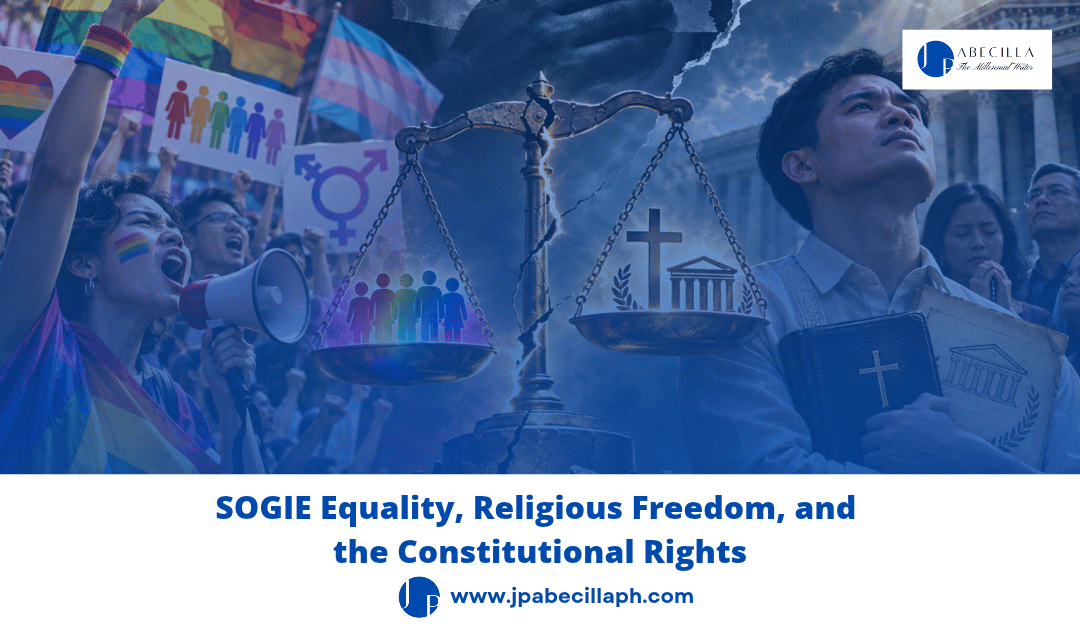
How can people demand tolerance while refusing to tolerate those who disagree with them?
That question has become increasingly relevant as the Philippines debates the proposed SOGIE Equality Bill.
On November 11, 2026, the House Committee on Women and Gender Equality approved several SOGIESC-related bills in principle for consolidation.
While the legislation remains under consideration, the debate has intensified, particularly over religious freedom, freedom of expression, parental rights, and the proposed criminal penalties.
Over the past week, my Facebook posts questioning the bill have reached millions of people. But the responses revealed something beyond political disagreement: the irony of people demanding respect while personally attacking those who challenge their views.
Here are five posts that sparked some of those discussions.
1. Equality for All, Not Special Rights for Some
My collection of quotations from prominent Filipino personalities, including Ricky Reyes, Jake Zyrus, Makati Mayor Nancy Binay, Bro. Eddie Villanueva, and Senator Tito Sotto, became one of my most widely viewed posts.
It highlighted an important reality: opposition to particular SOGIE-related policies does not come exclusively from religious conservatives. Even within the LGBT community, perspectives differ.
Equality should mean equal protection under the law, not immunity from disagreement or criticism.
The question is whether the proposed legislation protects everyone’s constitutional rights without unnecessarily restricting competing freedoms.
2. I Don’t Usually Engage With Pseudonymous Accounts
One of my posts responded to a critic who dismissed opposition to the SOGIE Bill as ignorance.
My response challenged the assumption that questioning legislation automatically makes someone hateful, discriminatory, or uninformed.
Disagreeing with a proposed law is not the same as denying someone’s humanity.
Legislation deserves scrutiny, especially when it introduces criminal penalties and potentially affects constitutionally protected freedoms.
Instead of questioning someone’s intelligence or motives, critics should engage with the actual provisions and arguments.
That is how meaningful public debate should work.
3. Ganon Ba? OK, Let Me Deal With It
This post responded to Juliana Parizcova Segovia’s statement:
“Whether I WAS BORN THIS WAY, or MADE THIS WAY, or CHOSE THIS WAY… DEAL WITH IT.”
My concern was not about dictating how another person should live.
It was about the expectation that everyone must accept another person’s beliefs about sexuality and identity without question.
Personal freedom does not eliminate other people’s freedom to disagree.
People should be free to live according to their convictions, but that freedom must coexist with religious liberty, freedom of conscience, and freedom of expression.
Respect must work both ways.
4. Naman… Who Should Tell Her?
Another discussion involved Benedictine nun Sister Mary John Mananzan, who expressed support for the SOGIE Equality Bill, saying it does not grant special rights and emphasizing respect and compassion.
My response was straightforward:
You don’t need a law to show respect and compassion. And you don’t need to be religious to believe in either.
Of course, anti-discrimination laws serve purposes beyond encouraging kindness.
But when legislation introduces criminal penalties, lawmakers must explain exactly what conduct is prohibited and how constitutional freedoms will be protected.
Compassion is a moral responsibility. Criminal punishment is an exercise of state power.
The distinction matters.
5. Vice Ganda vs. Tito Sotto: On SOGIE-Related Issues and Women’s Rights
My post revisited the public disagreement between Vice Ganda and Tito Sotto concerning biological sex, gender identity, and women’s rights.
Their contrasting perspectives reflect a continuing debate: How should society reconcile gender identity with biological distinctions that remain relevant to reproduction, healthcare, sports, and certain legal protections?
Recognizing biological differences does not automatically mean disrespecting people who identify differently.
Likewise, questioning particular gender-related policies should not automatically be characterized as hatred.
These questions deserve serious discussion, not personal ridicule.
A Gay Filipino Doctor Who Opposes the Bill
Perhaps one of the most revealing developments is the position of Dr. Ryan Borja Capitulo, a Filipino physician who openly identifies as gay.
In his November 2026 position paper, An LGBT Who Is Against the SOGIESC Equality Bills, he questions the necessity of the proposed legislation and raises concerns about religious freedom, parental rights, and possible legal consequences.
His position challenges the assumption that all LGBT Filipinos support the bill.
Being LGBT does not automatically mean supporting every policy proposed in the name of LGBT rights.
The community is not a single political or ideological bloc.
That diversity of opinion deserves recognition.
Beyond the Arguments: What This Debate Has Taught Me About Tolerance
Throughout these discussions, I’ve received accusations of being a homophobe, hypocrite, boomer, and even a closeted gay man.
Some critics have resorted to personal insults rather than addressing my arguments.
I am not suggesting that all LGBT individuals or SOGIE Bill supporters behave this way. But the conduct of certain advocates exposes a contradiction worth examining.
How can someone advocate acceptance while refusing to accept that others hold different religious, moral, or political convictions?
Tolerance does not require agreement.
And freedom of expression means little if we defend it only for people whose opinions we approve of.
Where Do We Go From Here?
The Constitution protects equality, religious freedom, freedom of expression, and other fundamental rights.
These protections must coexist.
The proposed SOGIESC legislation deserves careful examination, particularly concerning how different versions define prohibited acts, establish penalties, and safeguard religious and conscientious objections.
The goal should be clear: protect people from genuine discrimination without unnecessarily criminalizing constitutionally protected beliefs or expression.
No Filipino should face violence, harassment, or unjust discrimination because of sexual orientation or gender identity.
But neither should Filipinos be deprived of their constitutional freedoms simply because they question a proposed law or uphold traditional religious convictions.
As Congress continues its deliberations, we must demand transparency, constitutional clarity, and meaningful consultation.
TRUE TOLERANCE IS NOT THE ABSENCE OF DISAGREEMENT. IT IS THE ABILITY TO RESPECT PEOPLE’S RIGHTS EVEN WHEN WE STRONGLY DISAGREE WITH THEIR BELIEFS.
EQUALITY FOR ALL. CONSTITUTIONAL RIGHTS FOR ALL.
Discover more from JP Abecilla - The Millennial Writer
Subscribe to get the latest posts sent to your email.