
Marketing & Branding
Philippine Brands Are Already Showing Up in AI Search. But Here’s What Marketers Should Really Pay Attention To
Google search is no longer the only place where brands compete to be discovered.
Today, a potential customer can open ChatGPT, Gemini, or Perplexity and ask:
What is the best business loan provider in the Philippines?
Which condominium developer should I consider?
What companies offer managed IT services?
Instead of receiving ten blue links, the user gets an answer, often with only a handful of companies mentioned.
For marketers, that creates a new question: When AI answers a question about your industry, does it know your brand well enough to mention you?
A new Philippine study by digital marketing agency Spiralytics offers an interesting first look at that question. And some of its findings challenge assumptions marketers have carried over from traditional SEO.
Philippine brands appear surprisingly visible in AI answers
Spiralytics examined 1,146 buyer questions involving 26 companies: 16 Philippine brands across 14 industries and 10 US brands used as a comparison group.
After screening the questions, researchers identified 255 queries where the respective brands had a legitimate reason to appear: 155 involving Philippine brands and 100 involving US brands. Those questions were tested across ChatGPT, Google Gemini, and Perplexity between June and August 2026.
The headline result is striking:
Philippine brands appeared in at least one AI engine for 83.2% of the commercial questions they were considered relevant to.
The US comparison group appeared in only 40%.
That does not mean Philippine companies are somehow twice as good at AI marketing as American companies.
Spiralytics itself points out that competition within the respective markets differs. Its interpretation is that many Philippine categories simply have fewer companies competing aggressively for visibility inside AI-generated answers.
In other words, Philippine marketers may currently have something valuable: an early-mover window. But I think an even more important finding sits deeper in the study.
Your website isn’t doing all the talking anymore
Traditional digital marketing has trained companies to concentrate enormous effort on their own websites.
Improve your content.
Build landing pages.
Optimize your keywords.
Earn backlinks.
Increase domain authority.
Rank higher on Google.
Those things still matter.
But Spiralytics recorded 7,308 citations from AI-generated answers involving Philippine brands, and only around 5% of those citations pointed to websites owned by the brands themselves.
That means roughly 95% pointed somewhere else.
News websites.
Directories.
Industry articles.
Competitor sites.
Third-party publications.
Independent websites discussing those companies or their industries.
That changes the way marketers should think about brand visibility.
Your website tells the internet:
This is who we say we are.
Third-party sources tell the internet:
This is who other people say you are.
AI systems appear to rely heavily on that wider information ecosystem when constructing answers.
For marketers, this gives earned media, digital PR, credible directories, industry publications, reviews, citations, and independent brand mentions another potential function beyond their traditional benefits.
They aren’t simply creating referral traffic.
They may also be helping AI systems understand your brand.
Interestingly, backlinks alone may not be the answer
This is probably the finding I found most interesting.
If AI visibility simply worked like conventional SEO, we might expect websites with stronger backlink profiles and greater domain authority to dominate AI answers.
Spiralytics didn’t find that pattern.
According to its data, Philippine brands with Domain Ratings below 20 appeared in 95% of their relevant questions, while brands in the 20–39 range appeared in 71% and those at 40 or above appeared in 94%.
There was no straightforward progression where greater backlink authority reliably resulted in greater AI visibility.
One low-authority retailer reportedly appeared in every relevant answer tested, while a US law firm with a decades-old domain and substantially stronger authority failed to appear at all.
That doesn’t mean backlinks suddenly don’t matter.
It means we shouldn’t automatically assume that Google authority = AI authority.
Spiralytics points to separate Ahrefs research involving 75,000 brands that likewise found relatively modest correlations between Domain Rating and AI visibility. Brand mentions across external websites showed a much stronger relationship in that research.
That distinction is worth paying attention to.
A backlink and a brand mention aren’t necessarily the same signal anymore.
For years, marketers wanted another website to mention their company partly because they wanted the link. AI search may make the mention itself increasingly valuable.
AI also has an identity problem
Another lesson from the study is something traditional rank-tracking tools wouldn’t necessarily expose.
Sometimes a company isn’t invisible because it lacks content.
The AI simply doesn’t understand exactly which company it is.
Spiralytics identified three recurring problems in failed AI answers:
- The AI confused a Philippine company with another company abroad that had the same or a similar name.
- The AI hesitated because it could not confidently determine which organization the user meant.
- A subsidiary disappeared underneath a better-known parent company’s identity.
That should matter especially in the Philippines, where corporate groups, subsidiaries, similarly named businesses and umbrella brands are common.
You can have a technically excellent website and still suffer if information about your company across the web is inconsistent.
Your company name, description, location, ownership relationships, products, social profiles, directory listings and structured website information increasingly need to tell the same story.
Before asking: “How do we rank?”, marketers may need to start asking: “Does the internet clearly understand who we are?”
ChatGPT, Gemini and Perplexity don’t behave the same way
Another mistake would be treating “AI search” as a single channel.
Using the same 155 Philippine buyer questions, Spiralytics recorded substantially different brand-mention rates:
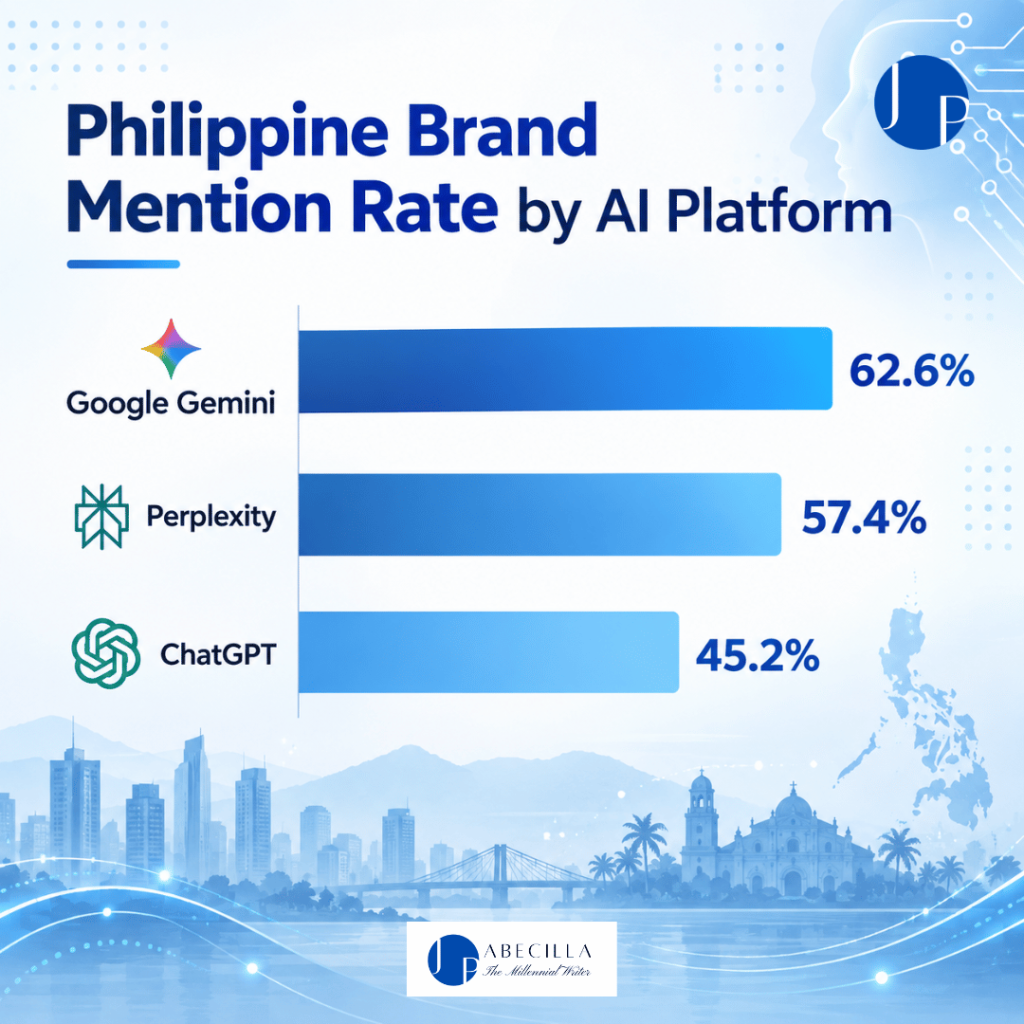
Interestingly, ChatGPT was the most conservative of the three in naming Philippine brands in this particular dataset.
So checking your company once on ChatGPT and declaring your brand either “visible” or “invisible in AI” isn’t a meaningful audit.
Different systems select, interpret, and present sources differently.
That’s very similar to an older marketing lesson we’ve already learned elsewhere: Never judge an entire channel from a single data point.
But we should not overstate the study
This research is useful, but marketers should also pay attention to its limitations.
Spiralytics is transparent that this was not a random survey of the entire Philippine marketplace. Its prompts were generated around specific brands, services, markets, and buyer situations.
The Philippine sample consisted of only 16 brands, while the comparison group contained 10 US companies. One of the Philippine brands was Spiralytics itself; removing it changed the Philippine visibility figure only slightly, from 83.2% to 82.5%.
The mix of questions also varied by brand, meaning the 83% Philippines-versus-40% US comparison shouldn’t be interpreted as a universal national benchmark.
And during this initial snapshot, each qualifying question was asked once per AI engine. Spiralytics says repeated testing is part of the next phase because generative AI answers can change between runs.
Those qualifications don’t make the research useless.
They simply mean we should treat it as an early Philippine market study, not a definitive law of AI search behavior.
That’s an important distinction.
So what should marketers actually do?
I wouldn’t abandon SEO and suddenly replace everything with the latest acronym.
Search rankings still matter. Websites still matter. Technical SEO still matters. Backlinks still matter.
The better approach is to expand the definition of search visibility.
For marketers, that means thinking across three layers:
First, own your identity.
Make it unmistakably clear who your company is, what it does, where it operates, and how its products or subsidiaries relate to the main brand.
Second, build authority beyond your own domain.
Earn legitimate coverage, industry references, reviews, credible directory listings and independent mentions. Don’t think only about getting a backlink. Think about whether trustworthy third-party sources accurately describe your company.
Third, answer real buyer questions.
Create content around what customers actually ask when they are comparing providers, evaluating products, understanding costs, investigating problems or making purchasing decisions.
Spiralytics calls the emerging discipline Answer Engine Optimization or AEO, optimizing a brand’s information environment so it has a better chance of appearing when AI systems formulate answers.
Whether AEO ultimately survives as a distinct marketing category or simply becomes part of SEO remains to be seen.
But the behavioral shift behind it is already significant.
The future of search may be less about getting the click
For more than two decades, digital marketing has revolved around a relatively straightforward objective:
Get discovered → get the click → get the visitor onto your website.
AI changes that sequence.
A potential buyer may now research your industry, compare several businesses, eliminate alternatives and build a shortlist before visiting a single company website.
That means visibility increasingly happens inside the answer itself.
And that makes reputation outside your own website even more important.
The most valuable takeaway from Spiralytics’ study isn’t that Philippine brands currently have an 83% AI visibility rate.
That figure will change.
The bigger takeaway is this:
Your brand is no longer defined online only by what you publish about yourself. Increasingly, AI systems are assembling your reputation from what the rest of the web says about you.
For marketers, that’s simultaneously an SEO problem, a content problem, a brand problem and a PR problem. And Philippine businesses may still have time to shape that story before their competitors do.