
Social Issues
After a Lifetime on Display, Did Mali Need to Remain on Display After Death?
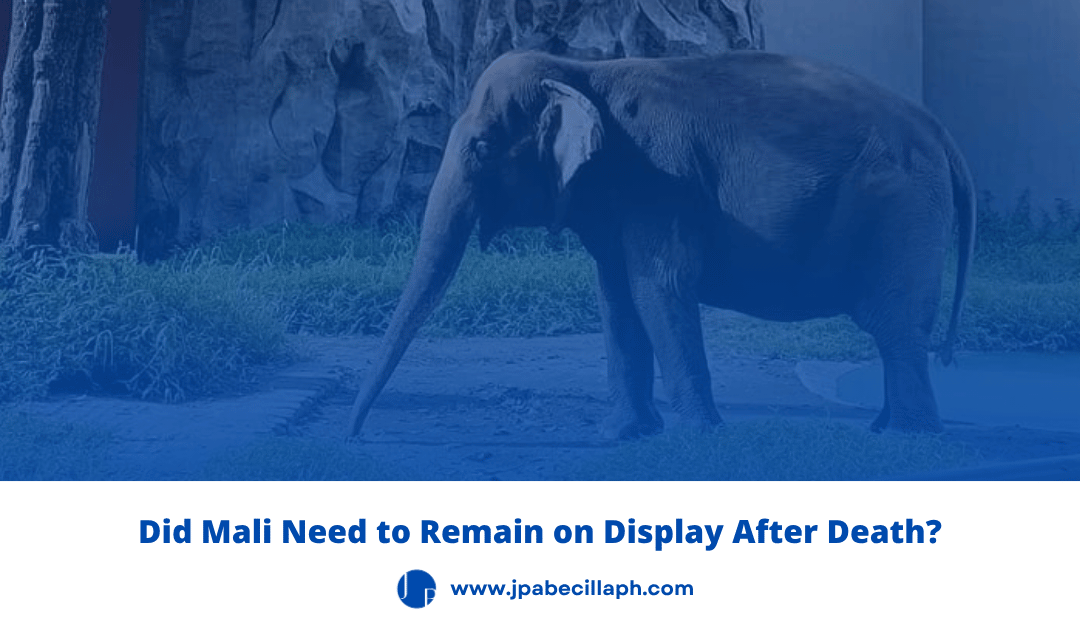
A few months before Mali died, I visited Manila Zoo and saw her for the first time.
I did not know it would also be the last.
When she died on November 28, 2023, I wrote a very short post:
“Yun na pala ang una at huling pagkakataon na makita ko ang nag-iisang elepante sa bansa na si Vishwa Ma’ali ng Manila Zoo. 😢 Salamat sa maiksing ala-ala. 🙏”
Almost three years later, Mali is in front of the public again; this time as a taxidermied specimen at the National Museum of Natural History. And I find myself struggling with it.
I understand the scientific and historical explanations for taxidermy. I understand why museums preserve animal specimens. But understanding something does not necessarily mean becoming comfortable with it.
In Mali’s particular case, I keep returning to one question: After spending almost her entire life being looked at by people, did we really need to keep looking at her after death?
Taxidermy Has Scientific Value. That Is a Fact.
It would be unfair to dismiss taxidermy simply as a gruesome practice with no legitimate purpose.
Natural-history museums have used preserved animal specimens for centuries. They allow scientists to study anatomy, physical variation, evolutionary change and species that may eventually become endangered or extinct.
The Natural History Museum in London calls taxidermy a “vital tool” for teaching people about the diversity of life. Properly prepared specimens can also preserve biological information for future study.
There is therefore real science behind preservation. But there is an important distinction that changed how I understand this issue.
The same Natural History Museum explains that mounted taxidermy specimens commonly appear in galleries, while scientists frequently use preserved skins for research. Collections can also include bones, skeletons, tissues and other biological material.
In other words: Scientific preservation and lifelike public display are not the same thing. Preserving part of Mali for research can have scientific value. Reconstructing her appearance so visitors can once again stand in front of her is also a curatorial and ethical decision.
That is the part I find more difficult to defend.
What We See Is Not Literally Mali’s Entire Corpse
It is also important to understand what taxidermy actually is.
A taxidermied animal is generally not an intact dead body simply preserved in place. The skin is removed and treated, much of the soft tissue is removed, and the preserved skin is fitted around a fabricated structure intended to recreate the animal’s shape. Artificial elements such as eyes may also be used.
The Natural History Museum describes taxidermy specimens as preserved animal material arranged over manufactured structures to imitate the appearance of a living animal.
Scientifically, that distinction matters. Emotionally, however, it does not completely resolve the problem for me. The skin still belonged to Mali. And the intention is unmistakable: to make a dead animal resemble the living animal people once knew.
That is precisely why taxidermy can be so powerful, and why it can also be unsettling.
Even Museum Ethics Recognises That Animal Remains Require Dignity
My discomfort is also not completely outside the thinking of the museum profession itself.
The International Council of Museums’ Code of Ethics for Natural History Museums specifically says: “Animal remains should be displayed with respect and dignity.”
It further acknowledges that what constitutes respect may vary depending on the country, culture, institution and audience. That is an important point.
The ethical question is therefore not settled simply by saying: “This is what museums do.”
Museums themselves recognise that the treatment and exhibition of animal remains involve ethical judgment. Taxidermy can be scientifically legitimate while a particular display can still be questioned.
Mali Was Not Killed for Taxidermy
There is also an important fact that should make this discussion fairer.
Mali was not killed so she could become a museum specimen.
She died after decades at Manila Zoo. The taxidermy decision came afterward.
That separates Mali’s case from darker periods in natural-history collecting when animals were sometimes deliberately killed to become museum specimens.
It also means taxidermy caused Mali no physical suffering after death. A dead animal no longer possesses consciousness or a functioning nervous system capable of experiencing pain.
So my objection cannot reasonably be: “Taxidermy hurt Mali.”
It didn’t.
The more difficult question is instead: What responsibility do humans have toward the remains of an animal whose entire life was already under human control?
That is no longer purely a scientific question. It is an ethical one.
And Mali Wasn’t Just Another Specimen
This is where Mali feels different to me.
She had a name. She had a documented history. Filipinos knew her.
Children grew up visiting her. Parents returned years later with their own children. Animal-welfare organisations campaigned over her condition and questioned whether an elephant, a highly social species, should spend decades without another elephant.
I became one of those visitors myself shortly before she died. Mali was therefore more than an anonymous biological sample. She was an individual animal whose captivity became part of a national conversation.
For nearly five decades, people looked at her behind the boundaries of Manila Zoo.
Then she died. Her skin was preserved. Her body was reconstructed. And now people can look at her again. That continuity is what troubles me most.
I Can Defend Isko’s Transfer. I Cannot Defend the Original Decision So Easily.
Politics has inevitably entered the discussion, so the timeline matters.
The decision to taxidermy Mali was not made by the current Isko Moreno administration.
After Mali died in November 2023, then-Mayor Honey Lacuna’s administration pursued her preservation. In January 2024, the Manila City Council authorised an agreement with a taxidermy service, with the preserved Mali intended for exhibition at Manila Zoo.
By the time Isko Moreno returned as mayor, the taxidermy had already been completed. His administration faced a different question: where should an already-taxidermied elephant be properly preserved?
In September 2025, Moreno announced the transfer to the National Museum, saying Manila lacked sufficient resources and specialised capability to maintain the specimen under the controlled conditions it required.
On that decision, I think Isko has a reasonable case.
The National Museum’s own technical specifications say that it has the expertise and capability to conserve Mali’s taxidermy for long-term preservation. The institution describes Mali as an “educational and commemorative specimen” and planned professional restoration, conservation and exhibition work around her.
If the taxidermied specimen already existed, moving it from Manila Zoo to professional museum care was sensible. But defending that transfer does not require me to defend the original decision to taxidermy Mali. Those are two different things.
Here’s a related post you must read:
Preservation Did Not Have to Mean Recreating Mali for Our Eyes
Perhaps this is where I ultimately stand.
I accept that preserving biological material from Mali can serve science and history.
Her bones, tissues, skin or other specimens could potentially contribute to research and education. Future generations deserve to learn about Asian elephants, conservation and the extraordinary story of the only elephant many Filipinos ever personally saw.
But I remain unconvinced that education required reconstructing Mali into a lifelike figure for permanent public viewing. We have photographs. We have videos. We have her history.
Museums can use skeletal material, biological specimens, replicas, digital reconstruction, archival footage and interactive exhibits to tell stories about animals.
Taxidermy is one way. It is not the only way.
And in Mali’s case, the symbolism matters.
An elephant who spent almost her entire life as a public attraction has now become a public attraction after death. I struggle with that.
This Isn’t About Being Pro-Isko or Anti-Isko
I support Isko Moreno and Chi Atienza on many issues.
But political support should never require defending every decision associated with people we support.
In fact, we should be able to distinguish between a defensible decision and one that deserves deeper examination. I think transferring an already-taxidermied Mali to the National Museum was defensible. I also think scientifically preserving useful parts of Mali can be defensible.
But personally, and after looking more deeply into the science rather than simply reacting emotionally, I remain uncomfortable with turning her reconstructed body into something the public continues to visit and photograph.
Maybe others will reach a different conclusion.
Taxidermy has legitimate scientific, historical and educational uses. That should be acknowledged. But science can explain how we preserve an animal. It cannot, by itself, answer whether we should display that animal as though she were alive.
That decision belongs to ethics, culture and our understanding of what constitutes dignity.
When I saw Mali a few months before her death, I was grateful for that brief encounter. If I visit her at the National Museum someday, I imagine it will feel very different. Because I will know that beneath the reconstruction is something that actually belonged to the animal I once saw alive.
Perhaps that discomfort itself is worth confronting.
Mali spent most of her life within spaces humans created for her. Humans decided where she lived, what environment she experienced and whether she would remain in Manila.
After her death, humans again decided what would happen to her remains. Maybe the most profound lesson she can leave us is to ask whether remembrance always requires possession.
We can preserve Mali’s history without pretending that we need to preserve everything about her for ourselves. And after a lifetime spent under our gaze, perhaps there is nothing unreasonable about wondering whether death should finally have allowed Mali to leave it.
Key resources
National Museum of the Philippines: Technical Specifications for Mali’s conservation and exhibition. The document describes Mali as an educational and commemorative specimen and explains the museum’s conservation objectives.
International Council of Museums: Code of Ethics for Natural History Museums. Particularly relevant is its standard that animal remains should be displayed with respect and dignity.
Natural History Museum, London: “Why is taxidermy still valuable?” A useful explanation of both the educational role of mounted specimens and the scientific use of preserved skins.
GMA News: “Mali’s preserved remains go on display at National Museum,” August 29, 2026. Provides the latest context surrounding the exhibit and the continuing debate over Mali’s life and captivity.
The Philippine Star: “Manila council OKs preserving Mali’s remains,” January 27, 2024. Documents when and under which administration the taxidermy arrangement was authorised.