
Economy & Class
Three Months Is No Longer Enough: Rethinking Emergency Funds in the Philippines
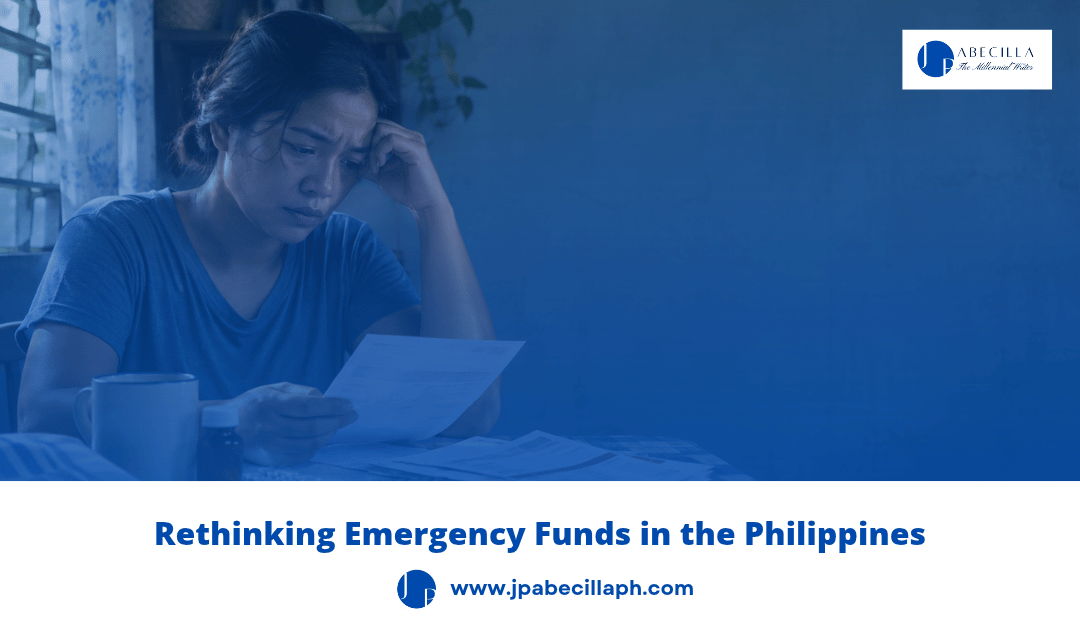
In an uncertain economy, I believe Filipinos should aim for six to nine months of emergency funds, with separate savings on top.
For years, one of the most common pieces of personal finance advice has been to maintain an emergency fund equivalent to three to six months of living expenses.
It sounds reasonable. Save enough to survive a few months without income, and you should have some financial security while looking for another job or recovering from an unexpected setback.
But given today’s economic realities, I have increasingly questioned whether three months is enough.
Personally, I believe six to nine months of emergency funds, supported by separate savings, is a more realistic financial goal, particularly for Filipinos with dependents, uncertain employment, or significant financial responsibilities.
And my argument goes beyond unemployment.
An emergency fund should not simply answer how long you can survive without a salary. It should also help you prepare for unexpected circumstances that can threaten your financial stability, whether you are employed or not.
Middle Class on Paper, Financially Vulnerable in Reality
In my previous article, Middle Class on Paper, Fragile in Reality: What ₱50,000–₱80,000 Really Means to a Filipino Family, I discussed why income classification alone does not necessarily reflect financial security.
A Filipino earning ₱80,000 monthly may appear financially comfortable. But what if that person supports five family members, pays for a parent’s maintenance medicines, finances a sibling’s education, and shoulders most household expenses?
That ₱80,000 becomes an entirely different story.
The same principle applies to emergency funds.
Having three months’ worth of expenses saved may look sufficient on paper. But the actual protection it provides depends on how much you spend, how many people depend on you, what insurance coverage you have, and how quickly you can recover financially.
The latest figures reinforce this concern.
According to the Philippine Statistics Authority’s 2025 Family Income and Expenditure Survey, the average annual income of Filipino families reached approximately ₱411,350 in 2025, while average annual expenditure reached ₱321,850.
Between 2023 and 2025, average family income increased by 16.5%, but average family expenditure grew faster, at 24.7%.
These national averages do not describe every household, but they illustrate the financial pressures families must navigate.
Earning more money does not automatically mean becoming financially secure, especially when financial obligations are increasing alongside income.
An Emergency Is Not Always About Losing Your Job
When people discuss emergency funds, unemployment is usually the first scenario they mention.
But what about a sudden illness requiring hospitalisation? A serious accident? A family member needing urgent medical treatment? A fire, flood, or typhoon damaging your home?
These emergencies can happen while you are fully employed and earning a regular salary.
In the Philippines, healthcare remains a particularly significant financial concern.
According to the PSA’s 2025 Philippine National Health Accounts, households directly shouldered 41.2% of the country’s current healthcare expenditure through out-of-pocket payments.
This is a share of national healthcare spending, not a percentage that every patient pays. Nevertheless, it demonstrates how substantial the direct financial burden of healthcare remains.
PhilHealth provides important coverage, but benefits vary according to medical conditions, applicable packages, and other requirements. Its inpatient benefits generally operate through case-based payments rather than a universal guarantee that every hospital expense will be covered.
A single serious hospitalisation could therefore consume a substantial portion of a family’s emergency fund.
Imagine having ₱90,000 saved because your essential expenses average ₱30,000 monthly. That represents three months of financial protection.
But what happens if a medical emergency costs ₱100,000 after insurance coverage?
Your entire emergency fund could disappear, and you would still have expenses to pay.
Now imagine losing your job shortly afterwards.
Emergencies do not always arrive one at a time.
That is precisely why I believe financial preparedness should extend beyond the traditional three-month benchmark.
The Changing Job Market Adds Another Layer of Risk
Employment security is another reason I favour a larger financial buffer.
The job market is evolving, and artificial intelligence is accelerating that transformation. Employers increasingly expect workers to adapt to new technologies, develop additional competencies, and demonstrate skills that remain valuable as routine tasks become automated.
A February 2026 International Labour Organization study on generative AI and Philippine employment estimated that 12.7 million Filipino jobs, more than one-quarter of employment, have some exposure to generative AI.
However, the ILO also emphasised that exposure does not necessarily mean job displacement. Only 3.6% of Philippine jobs were classified in the highest exposure category, while job transformation is expected to be a more widespread effect.
That distinction matters.
AI is not simply eliminating jobs. It is changing what many jobs require.
For employees whose skills are becoming less competitive, finding suitable new employment may require additional training, career adjustments, or a longer job search.
And even without AI, job opportunities differ significantly across industries, locations, experience levels, and economic conditions.
If you suddenly lose your job, can you realistically find another position offering comparable compensation within three months?
Perhaps. But what if you cannot?
An emergency fund should give you enough time to recover without forcing you to accept every financial or employment decision out of desperation.
Why I Prefer Six to Nine Months of Emergency Funds
The usual three-to-six-month recommendation remains a useful starting point. But it should not be treated as a universal standard.
Interestingly, the Bangko Sentral ng Pilipinas’ Personal Financial Management Trainer’s Guide, developed with education partners, recognises emergency fund targets ranging from three to six months to six to nine months or more, depending on personal circumstances.
It also emphasises keeping emergency funds separate from other savings goals.
Consider someone whose essential monthly expenses amount to ₱30,000.
| Emergency fund coverage | Amount needed |
|---|---|
| 3 months | ₱90,000 |
| 6 months | ₱180,000 |
| 9 months | ₱270,000 |
The difference is substantial.
A ₱90,000 emergency fund might provide a reasonable buffer against temporary unemployment. But if a major medical or family emergency consumes much of that amount, the household could suddenly find itself financially vulnerable.
With ₱180,000 to ₱270,000, there is potentially more room to absorb unexpected expenses while preserving some financial stability.
Of course, even nine months of expenses may not cover every possible crisis. Insurance protection and other financial safeguards remain important.
The point is not that nine months guarantees security.
It is that a larger reserve gives you more options when things go wrong.
Emergency Funds and Regular Savings Should Have Different Purposes
This brings me to another important distinction.
I believe we should stop treating emergency funds and general savings as though they automatically serve the same purpose.
Emergency funds should be reserved for genuine, unexpected financial problems, such as income loss, urgent medical expenses, major home repairs, or other unavoidable emergencies.
Separate savings should support planned expenses and financial goals: education, travel, home improvements, major purchases, professional development, or other responsibilities that can reasonably be anticipated.
Keeping these funds separate helps prevent everyday spending and planned purchases from gradually weakening your emergency reserve.
For me, the ideal financial structure includes an accessible emergency fund covering six to nine months of essential expenses, savings for specific financial goals, appropriate insurance coverage, and investments intended for longer-term wealth creation.
These resources have different purposes. A stock portfolio, for example, should not automatically be counted as readily available emergency cash because investments can lose value precisely when you need the money.
And while regular savings can serve as an additional backup, they should not be counted twice when assessing your actual financial protection.
This approach may appear conservative, but I would rather maintain additional liquidity than be forced to sell investments, borrow money, or exhaust my savings during an emergency.
But Can Ordinary Filipinos Realistically Save That Much?
Here is where the discussion becomes more complicated.
Recommending six to nine months of emergency funds is easy. Actually building that amount is another matter.
For millions of Filipinos, saving remains a struggle.
The BSP’s 2025 Consumer Finance and Inclusion Survey revealed that 48% of Filipino adults considered raising emergency funds very difficult, while another 15% said they could not do it at all.
Those findings should remind us that financial preparedness is not simply a matter of discipline.
Many workers are supporting entire households with limited incomes. Others are dealing with debt, unstable employment, medical expenses, or family obligations that consume most of their earnings.
Some families are not choosing between saving ₱5,000 and spending ₱5,000 on luxuries. They are choosing between saving and paying for food, electricity, transportation, or medicine.
We should acknowledge that reality before lecturing people about financial responsibility.
A six-to-nine-month emergency fund should be an aspirational financial target, not a measure of someone’s competence, discipline, or worth.
If you can only save ₱500 or ₱1,000 monthly, start there. Build the first month of essential expenses, then three months, then six, and eventually nine if circumstances allow.
Progress matters, even when it is slow.
But personal financial discipline cannot solve every structural problem. Better wages, accessible healthcare, decent employment opportunities, stronger social protection, and affordable essential services are equally important in building financially resilient Filipino households.
Financial Security Is About Having More Options
My argument is not that the conventional three-month emergency fund is useless.
Far from it.
For someone who has never maintained savings, building even one month of expenses is already an important achievement. Three months is a meaningful milestone. Six months can provide greater protection.
But I believe we should be more ambitious when our circumstances allow it.
In an economy where job requirements are changing, household responsibilities remain substantial, and medical emergencies can impose serious financial burdens, six to nine months of emergency funds (with separate savings on top) is a more prudent long-term goal.
It is not merely about surviving without a salary.
It is about being able to face a family crisis without immediately borrowing money. It is about having time to recover from unemployment. It is about avoiding unnecessary financial desperation when unexpected circumstances arise.
In my previous article, I argued that being middle class on paper does not necessarily mean being financially resilient in reality.
The same principle applies here.
Having a salary, a savings account, or even an investment portfolio does not automatically mean you are prepared for a serious financial crisis.
What matters is how much protection those resources actually provide when life stops going according to plan.
Three months may be a good beginning. Six months offers more protection. But for those who can afford to prepare further, I believe nine months, supported by separate savings, is an even stronger financial foundation.
Because financial security is not simply about how much money you earn or accumulate.
It is about how much uncertainty you can withstand without losing everything you have worked so hard to build.
And sometimes, the real test of financial stability is not the first emergency.
It is whether you can survive the next one.
This article builds on my earlier commentary, Middle Class on Paper, Fragile in Reality, and examines financial resilience through the lens of emergency preparedness, healthcare costs, and employment uncertainty in the Philippines.
The six-to-nine-month recommendation reflects my personal financial perspective, not a universal requirement. Actual savings targets should depend on essential expenses, dependents, insurance coverage, income stability, and individual circumstances.
Discover more from JP Abecilla - The Millennial Writer
Subscribe to get the latest posts sent to your email.