
Philippine Politics
Can Gibo or Leni Beat Sara Duterte in 2028? The Coalition Math Says It Is Possible

As early as 2026, Vice President Sara Duterte is unquestionably the person to beat in the 2028 presidential election.
That should be acknowledged before making any serious argument about who might defeat her.
But being the frontrunner more than a year before the filing of candidacies is not the same thing as having the presidency locked up. Recent surveys show something more complicated: Sara possesses an extraordinarily strong political base, particularly in Mindanao, but there is also a substantial electorate outside that base that is already willing to support an alternative.
Among the names being discussed, two are particularly interesting to me: Naga City Mayor Leni Robredo and Defense Secretary Gilberto “Gibo” Teodoro Jr.
They arrive at that discussion from very different places.
Leni already has polling evidence demonstrating that she can compete nationally against Sara. Gibo does not, not yet, as I mentioned on my Facebook page. His potential candidacy would instead depend on whether his credentials, national-security profile and access to a broader political coalition could be transformed into actual votes.
And if somehow these two political figures ended up on the same side, as I want to explore, the electoral equation could become considerably more interesting.
This is not a prediction that a Gibo-Leni tandem will happen. Leni has repeatedly said that she intends to remain in Naga and will not seek national office in 2028, while Gibo has merely said that he will keep his options open when the time comes.
It is instead a question worth examining:
Could either Gibo or Leni defeat Sara Duterte, and would a broad coalition involving both make that possibility stronger?
The available evidence says yes, it is possible. But it would require considerably more than simply combining their names on a poster.
Sara Duterte is ahead, and by a significant margin
Any analysis that begins by declaring Sara weak would be detached from reality.
Pulse Asia’s nationwide survey conducted from June 28 to July 6, 2026 placed Sara at 49% in a six-way presidential scenario. Leni Robredo followed at 26%, with Senator Raffy Tulfo at 14% and the remaining candidates at one percent or less.
In a hypothetical one-on-one contest conducted during the same polling period, Duterte led Robredo 52% to 39%.
Those are not small advantages.
Sara also enjoys something every potential challenger must take seriously: a powerful reservoir of public trust. In Pulse Asia’s July 2026 survey, 58% of Filipinos expressed trust in the vice president, compared with 27% who distrusted her. Her performance approval rating was 56%.
So no serious campaign should begin with the assumption that Sara Duterte can simply be defeated by putting together enough anti-Duterte politicians.
She currently has genuine mass support. But there is another side to those numbers.
Leni is much closer to Sara in a two-person race than the 2022 election might suggest
Leni Robredo lost decisively to Ferdinand Marcos Jr. in 2022. Marcos received roughly 31.63 million votes, compared with Robredo’s approximately 15.04 million. Sara, running separately for vice president, received more than 32 million votes.
It would therefore be easy to assume that another Robredo presidential candidacy would simply reproduce 2022.
Current polling does not support that assumption.
In Pulse Asia’s February 27-March 2, 2026 head-to-head scenario, Sara led Leni by only 51% to 43%—an eight-point difference.
A May Pulse Asia survey found Sara ahead 51-41.
OCTA Research’s second-quarter survey, released in August, produced a 43-34 Duterte-Robredo result, with a notably large 22% either undecided, supporting neither candidate or declining to answer. OCTA noted that Sara’s advantage had narrowed from 11 points in its first-quarter survey to nine points.
Different surveys use different questionnaires, candidate configurations and sampling periods, so these numbers should not be mashed together as though they measure exactly the same thing.
But the broad conclusion is difficult to miss: Leni Robredo is currently the most clearly demonstrated non-Duterte contender capable of attracting something approaching four in ten voters in a direct contest with Sara.
That is not victory. But neither is it political irrelevance.
The geographic numbers reveal Sara’s great strength, and her potential vulnerability
Sara Duterte’s biggest electoral fortress is extraordinary. It is Mindanao.
In the March Pulse Asia head-to-head matchup against Leni, Sara received a remarkable 93% in Mindanao, compared with Robredo’s six percent. Sara also dominated the Visayas, 67% to 31%.
But the same poll showed the opposite phenomenon in the rest of Luzon.
Robredo led there 67% to 26%.
Metro Manila was essentially tied, with Robredo at 42% and Duterte at 41%.
The May survey told a similar story. Robredo led in Balance Luzon 55% to 33%, while Duterte and Robredo were statistically close in NCR at 48% and 46%, respectively.
By July, in the broader six-candidate scenario, Sara and Leni were tied at 31% in Balance Luzon, while Sara’s strongest support continued to come from Mindanao and the Visayas.
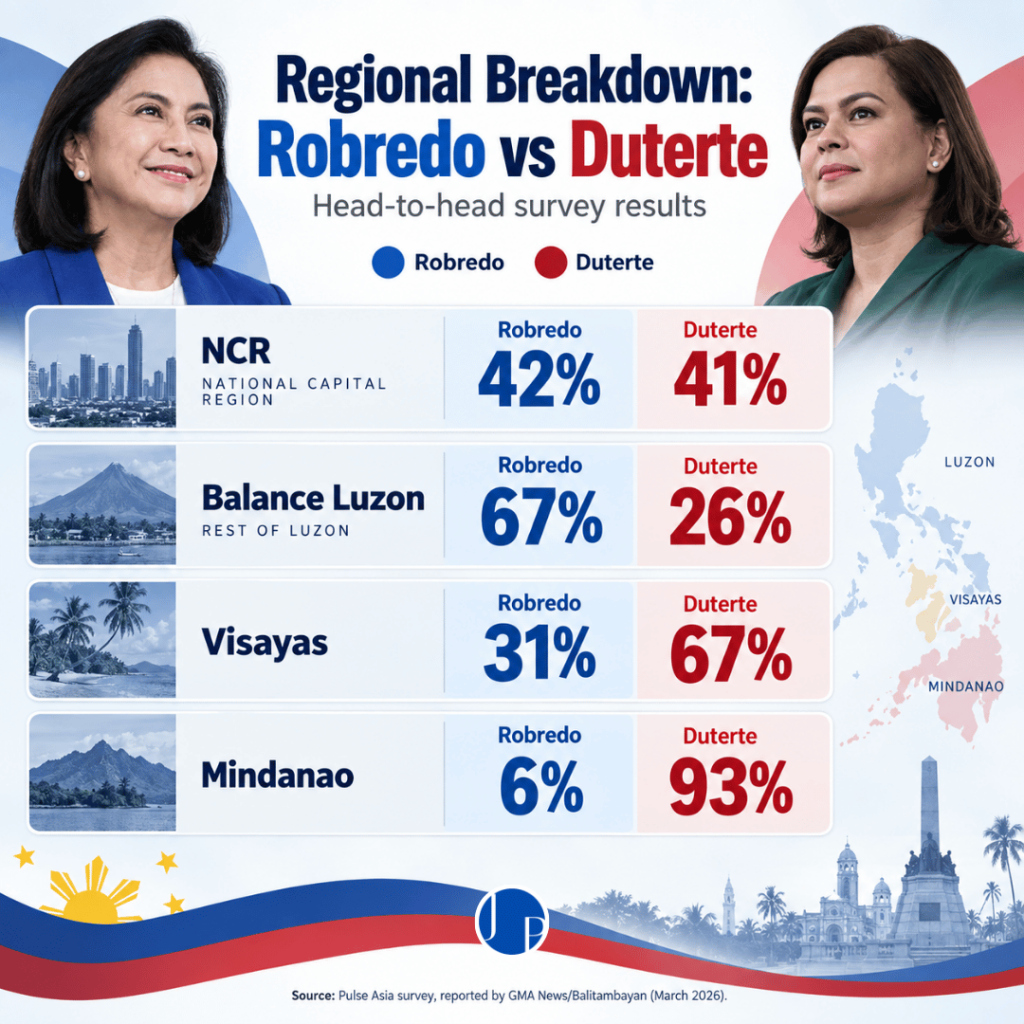
This matters because Sara’s national dominance is not geographically uniform.
Her Mindanao numbers are enormous, almost plebiscitary in some surveys. But presidential elections are won nationally.
A challenger does not necessarily need to defeat Sara in Mindanao.
The challenger needs to reduce the Mindanao deficit, compete much more strongly in the Visayas, and build sufficiently large margins in Luzon and Metro Manila to compensate.
That is where coalition-building becomes crucial.
Philippine presidential elections make coalition unity unusually important
The Philippines does not require a presidential candidate to win 50% of the national vote.
Under Article VII, Section 4 of the Constitution, the candidate receiving the highest number of votes is elected president. There is no second-round runoff merely because nobody achieves a majority.
That means fragmentation can determine the presidency.
Imagine an electorate in which roughly half supports Sara Duterte while the other half is divided among Leni Robredo, Gibo Teodoro, Raffy Tulfo, Bam Aquino, Risa Hontiveros or several other candidates.
Sara could win comfortably without gaining another voter.
But if large sections of that non-Duterte electorate converge behind one candidate, the arithmetic changes dramatically.
This is why the most important question for 2028 may eventually become not simply “Who can beat Sara?”
It could become:
“Who can assemble the broadest coalition without destroying his or her own credibility in the process?”
Why Leni has the clearer electoral path
Between Leni and Gibo, Leni’s path is currently easier to demonstrate with actual numbers.
First, she already possesses a national political base.
More than 15 million Filipinos voted for her for president in 2022.
Before that, she demonstrated an ability to win a national race under difficult circumstances. In 2016, she defeated Ferdinand Marcos Jr. for the vice presidency with 14,418,817 votes.
Second, her political network has shown that it survived the 2022 defeat.
The 2025 midterm election produced one of the clearest pieces of evidence. Bam Aquino finished second nationally with 20,971,899 votes, while Kiko Pangilinan finished fifth with 15,343,229.
Both performed dramatically better than many observers expected.
GMA’s examination of their results found that Aquino topped numerous vote-rich provinces and major cities, while Pangilinan also broke into the winning circle across many of the country’s largest voting areas. Their campaign credited not only their traditional supporters but also expansion among voters who had not previously belonged to their political base.
That is important.
A successful 2028 coalition cannot simply recreate the Pink rallies of 2022.
It has to expand beyond them.
Bam and Kiko’s 2025 performance provides evidence that candidates associated with the Robredo political ecosystem can still do exactly that when their message reaches beyond partisan identity.
But Leni also faces an enormous challenge: Mindanao and significant portions of the Visayas remain strongly Duterte.
A Robredo candidacy that merely consolidates the existing anti-Duterte vote probably loses.
A Robredo-led coalition that attracts moderates, independents, former Marcos supporters, non-Duterte conservatives, business constituencies, local political organizations and voters concerned about governance rather than political color becomes considerably more formidable.
That is precisely where somebody such as Gibo becomes interesting.
Gibo’s case is very different
There is currently no major nationwide poll showing Gibo Teodoro defeating, or even approaching, Sara Duterte.
That has to be stated plainly.
Anyone claiming today that Gibo already has the numbers to beat Sara is making a prediction, not reporting an established fact.
His history also provides a warning.
Gibo was the administration presidential candidate in 2010. He possessed impressive credentials, a major political party and extensive local-government support. Yet he remained fourth in the presidential race.
Even before election day, reporting noted how his strong academic and professional résumé had failed to translate into broad national voter preference.
That experience should destroy one particularly tempting myth: intelligence and qualifications do not automatically win Philippine presidential elections.
Neither does machinery by itself.
Gibo would need to demonstrate that the political environment of 2028 is fundamentally different from 2010, and that he himself has learned how to transform competence into a mass political connection.
There are reasons to think he would enter such a race with assets he did not possess in quite the same form sixteen years earlier.
Today he is not merely “the Harvard-educated bar topnotcher.” He is Defense Secretary during one of the most consequential periods in Philippine national-security policy.
His increasingly hard position toward Beijing has given him an identifiable national issue. China itself imposed sanctions on Teodoro and his immediate family in June 2026, citing his statements and actions concerning China. Reuters reported that the sanctions included travel restrictions and prohibitions on Chinese entities doing business with him or his family.
At the Shangri-La Dialogue, Teodoro publicly argued that Chinese pressure remained a serious threat to the Philippines and emphasized stronger Philippine defense capabilities and partnerships.
Whatever one’s opinion of the Marcos administration, Gibo therefore has something that many technocratic politicians lack: a nationally understandable leadership issue, defending Philippine sovereignty.
And unlike Leni, who has ruled out a 2028 national candidacy as of this writing, Gibo has deliberately kept the door open. On September 11, he said he would examine his options closer to 2028 after finishing his present responsibilities.
Still, Gibo would face a serious political problem.
If he entered the race merely as Marcos’s candidate, he could inherit the administration’s liabilities along with its machinery.
President Marcos’s July Pulse Asia numbers were weak: only 28% trusted him, while 51% expressed distrust, and half of respondents disapproved of his performance.
So the administration label alone would not guarantee Gibo a winning coalition.
His challenge would be to become something broader: credible enough to attract administration-aligned local politicians and institutions while sufficiently independent to attract voters who do not want either another Marcos or another Duterte presidency.
That is a difficult balancing act.
Why a Gibo-Leni coalition could theoretically change the race
This is where the idea becomes politically fascinating.
Gibo and Leni are not natural political twins.
Their histories, constituencies and alliances differ considerably.
But precisely because their bases are different, a genuine coalition between their political worlds could potentially reach voters that neither side can reach alone.
Leni brings an existing nationwide reform constituency, a volunteer network, strong support in significant parts of Luzon, credibility among voters focused on accountability and governance, and demonstrated ability to mobilize younger and civic-minded supporters.
Gibo potentially brings national-security credibility, a more conservative and technocratic image, relationships with political and institutional actors who would never naturally belong to a traditional Liberal/Pink coalition, and possible access to segments of the Marcos-aligned political establishment looking for a post-Marcos vehicle.
Put simplistically:
Leni can reach people Gibo cannot.
Gibo can potentially reach people Leni cannot.
That is what makes a coalition potentially more valuable than merely adding two sets of poll numbers.
Coalitions work when they expand the electorate.
They fail when they merely rearrange existing supporters.
But a coalition cannot be only “anti-Sara”
This would be the greatest danger.
A Gibo-Leni alliance built solely around stopping Sara Duterte would almost certainly be weaker than its supporters imagine.
Sara already possesses a powerful political narrative: conflict with the Marcos administration, identification with her father’s political legacy, and a deeply committed regional base.
Trying to defeat that solely with “anyone but Sara” would allow her to present herself as the victim of an alliance of political elites organized against the Dutertes.
The alternative coalition would therefore need an affirmative reason to exist.
It would have to answer questions such as:
- What kind of economy does it want?
- How will it lower the cost of living?
- How will it improve agriculture and food security?
- What is its approach to China and the West Philippine Sea?
- How will it reform education?
- How will it professionalize government?
- What will it do about corruption?
- How will it strengthen local governments?
- How will it address inequality while maintaining economic growth?
And, perhaps most importantly, can politicians from historically competing camps agree on rules that apply even when those rules hurt their own allies?
Without a coherent answer, “unity” becomes another electoral slogan.
The Philippines has already seen how quickly political unity based primarily on electoral convenience can disintegrate after victory.
A strong Senate slate would matter too
A presidential coalition becomes much more credible when voters can see the beginnings of a governing team rather than a personality cult.
The 2025 Senate election showed that there remains electoral room for candidates who do not belong neatly to either the Marcos or Duterte camp.
Bam Aquino finished second. Kiko Pangilinan finished fifth. At the same time, Duterte allies Bong Go and Ronald dela Rosa finished first and third.
That result is politically revealing.
Filipino voters are perfectly capable of producing a mixed ballot.
They do not necessarily think in rigid partisan blocs.
A broad 2028 coalition could therefore offer something much more compelling than “Gibo versus Sara” or “Leni versus Sara.”
It could present a governing coalition containing credible figures from reformist, centrist, technocratic, local-government and national-security backgrounds.
That would make the election less about political families and more about competing visions of government.
So, can Gibo or Leni actually beat Sara?
Leni: yes, demonstrably possible, but she is currently behind.
Current polling shows that she is not the favorite, but she is within a range where political events, coalition consolidation and changes in voter sentiment between 2026 and 2028 could make the contest genuinely competitive.
Her greatest task would be to expand beyond her existing political identity and dramatically improve her position in the Visayas and Mindanao.
Gibo: possible, but unproven.
There is no comparable polling evidence yet showing him within striking distance of Sara.
His path would depend on constructing a constituency that currently does not exist as one unified electoral bloc: reformists, moderates, administration-aligned politicians looking beyond Marcos, national-security voters, independents and other Filipinos uncomfortable with another Duterte presidency.
And that is why I find the possibility of Gibo and Leni working together more interesting than either one simply running alone.
Not because putting two famous names together automatically wins elections. It doesn’t.
But because defeating a candidate with Sara Duterte’s geographic base and current polling strength probably requires something larger than the traditional opposition, and something broader than the remnants of the Marcos administration.
It requires a coalition capable of saying to Filipinos:
You do not have to choose between political dynasties, old political wars and permanent partisan revenge. There is another option.
Whether Gibo and Leni would ever agree to become that option is an entirely different question.
As of September 2026, there is no Gibo-Leni tandem. Leni says she is staying in Naga. Gibo has not declared a presidential candidacy. Sara remains the clear polling frontrunner.
Those are the facts.
But elections are not held in September 2026.
They will be held in May 2028.
And if there is one conclusion that the numbers already allow us to make, it is this: Sara Duterte is formidable, but she is not mathematically, politically or electorally unbeatable.
A fragmented field greatly favors her.
A broad, credible and disciplined coalition could make 2028 a very different race.
And if that coalition somehow manages to combine the constituencies represented by Gibo Teodoro and Leni Robredo, then the “Eagle of Davao” could finally face an opponent, or a partnership, capable of giving her the toughest fight of her political career.