
Political Ideas
Where Have Cebu’s Political Bloggers Gone? The Gap Between Vlogging, Partisanship and Long-Form Political Writing
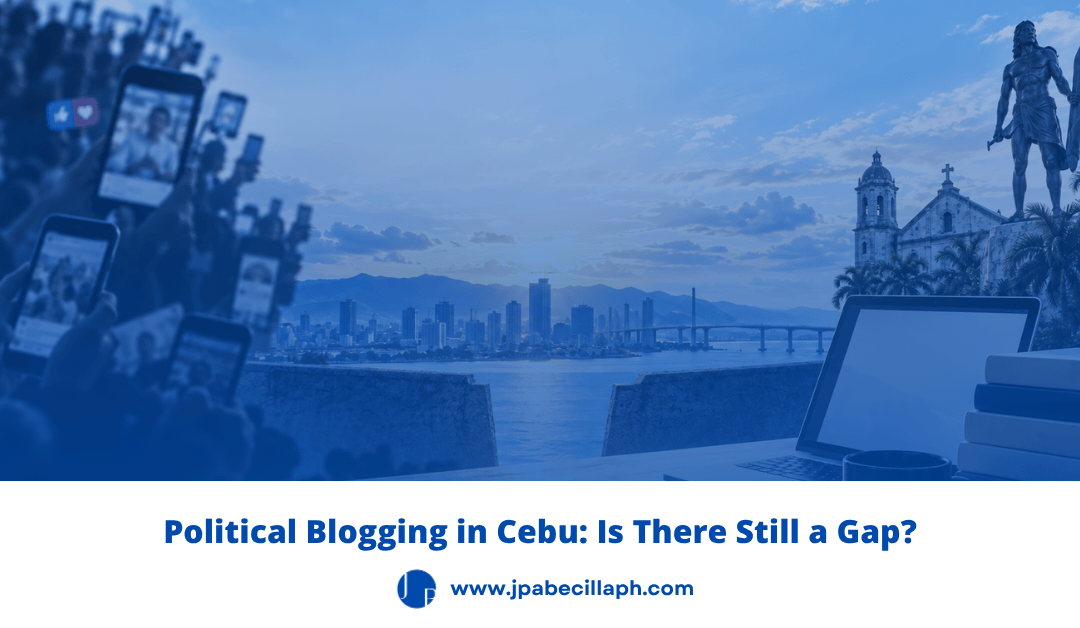
Cebu has never lacked political opinion.
Turn on local radio, read a newspaper column, scroll through Facebook, or open YouTube and you will find Cebuanos debating presidents, governors, mayors, political dynasties, national controversies and almost everything in between.
What Cebu appears to have much less of today is something more specific: the independent political blogger who consistently publishes researched, long-form political commentary on a personal website.
That distinction matters.
The problem is not that Cebu has no political voices. It has plenty. The gap is in the kind of political writing that sits somewhere between traditional journalism and the increasingly personality-driven world of Facebook posts, livestreams and political vlogging.
And perhaps that is a space JP Abecilla – The Millennial Writer can help rebuild.
Related post: Raising the Standard of Political Blogging in the Philippines
Political blogging in Cebu has always been a small world
The shortage is not entirely new.
In 2011, during a Cebu forum on the Filipino blogosphere and political participation, blogger Vernon Go remarked that there were not many political bloggers in Cebu and specifically remembered Kevin Ray Chua and Jerry Gervacio among the few he knew at the time. That observation was not a scientific census, but it offers a useful snapshot of how small Cebu’s political-blogging scene already was more than a decade ago.
Both names belong to Cebu’s early blogging history. The Cebu Bloggers Society says Jerry Gervacio and Kevin Ray Chua were among those who joined founder Mark Monta during the organisation’s formative period beginning in 2008. Kevin also became known for politically oriented blogging, including an early site supporting Mar Roxas well before the 2010 presidential election.
Those were the years when the word blogger usually meant someone who owned or maintained an actual blog.
You wrote an article. You published it on your website. It stayed there. Google could find it years later. Readers could return to it. Arguments could develop beyond a caption or a two-minute video.
The internet has changed dramatically since then.
Political blogging did not disappear. It changed form.
Facebook, YouTube, TikTok and livestreaming have gradually absorbed much of what used to happen in independent blogs.
That transformation produced a different type of political communicator: the political vlogger, influencer, commentator or social-media personality.
Cebu has prominent examples.
Ernesto “Jun” Abines Jr. deserves recognition in any discussion of Cebu’s online political scene. His Blogger profile dates to 2007 and still lists the DDS-Cebu Blog among his sites. In more recent years, however, his public political identity has increasingly been that of a political vlogger and commentator rather than merely a conventional blogger.
The same is true of Elmer “EB” Jugalbot. EB has become a visible Cebuano political commentator and vlogger, particularly within the Duterte-aligned political movement. In 2025, both EB and Jun were publicly described as active Cebuano political vloggers and participants in Maisug-related political activities.
Their continued presence matters.
They demonstrate that Cebuano voices can participate in national political discourse without waiting for Manila-based media to provide the microphone.
Jun and EB have built audiences, taken political positions publicly and turned online commentary into participation in real-world political movements. The Freeman, for example, reported on EB’s role as a Maisug-Cebu co-convenor, while Jun has remained active in political organising and public commentary.
One does not have to agree with their politics to acknowledge their place in Cebu’s digital political landscape. But their prominence also helps illustrate what is missing.
The missing space is not another partisan vlogger
Political content online increasingly rewards certainty.
Choose a camp.
Defend its politicians.
Attack the other camp.
Post quickly.
React faster.
Turn every controversy into another piece of evidence that your side is right and the other side is destroying the country.
That formula works extraordinarily well on social media because platforms reward emotion, immediacy and engagement.
But politics deserves other forms of writing too.
A city and province as consequential as Cebu should have room for political writers who ask questions that do not begin with Which politician do I support?
Questions such as:
- Why does Cebu continue to struggle with particular infrastructure problems?
- Which local-government programs actually work?
- What can Cebu learn from other Asian cities?
- How effective are our political dynasties once their records are examined instead of their surnames?
- What is happening to Metro Cebu’s transportation, housing, flooding, waste management and urban development?
- What should Cebuanos expect from their representatives in Congress?
- How should Cebu position itself within Philippine national development?
- And when a politician we support makes a poor decision, are we willing to say so?
These questions are less suited to political fandom.
They are much better suited to political blogging.
There is still political commentary in Cebu, just not necessarily blogging
It is important not to exaggerate the gap.
Cebu still has experienced newspaper columnists, journalists and commentators writing about politics. SunStar and The Freeman continue publishing political opinion on Cebu and national affairs. Recent columns, for example, have examined Cebu’s political culture, leadership and representation.
So it would be wrong to claim that Cebu is intellectually silent. It is not.
The distinction is institutional.
A newspaper columnist writes within a media organisation. A broadcaster works within broadcasting. A political vlogger primarily operates through social-media platforms.
An independent blogger owns a different kind of space.
The website becomes an archive of the writer’s thinking.
That matters because Facebook posts disappear into timelines. Videos can become difficult to revisit. Algorithms determine whether old material gets seen again.
A blog article can remain searchable for years.
The best political blogging therefore does something social-media commentary often cannot: it creates a public record of arguments.
Where The Millennial Writer can fit
This is where I believe JP Abecilla – The Millennial Writer has an opportunity.
Not to declare himself Cebu’s only political blogger.
That would be both unnecessary and impossible to establish conclusively. There may be independent writers, small blogs or emerging creators that a search simply fails to uncover.
Nor should the objective be to replace Jun Abines, EB Jugalbot, traditional journalists or anyone else. The opportunity is to occupy a different lane.
The Millennial Writer can become a Cebu-based platform for political commentary that combines several things that rarely appear together: long-form writing, searchable archives, Cebu perspective, public-policy curiosity, political independence and professional communication.
That last part matters.
My background is not in elected government or professional journalism. I work in marketing and have spent years writing, blogging and communicating professionally.
That means my contribution should not pretend to be something it is not.
I am not a political scientist.
I am not a lawyer interpreting every constitutional dispute.
I am not an investigative newsroom.
And I am certainly not a neutral machine without opinions.
I have supported political candidates. I have political friendships and preferences. Readers should know those things rather than discover them later and reasonably wonder whether they were being hidden. But having political preferences does not require political idolatry.
There is a difference between supporting a politician and surrendering your judgment to one.
A different rule for political support
The standard I want this platform to develop is simple:
- Praise what is good.
- Defend what is fair.
- Question what is unclear.
- Correct what is wrong.
- Put country above politician.
That sounds straightforward.
In Philippine politics, it is surprisingly difficult.
Supporters often interpret criticism as betrayal. Critics sometimes interpret acknowledgement of good performance as surrender. Politics becomes a contest in which every fact must somehow benefit the tribe.
A serious political blog should resist that pressure.
If Isko Moreno does something effective, I should be able to explain why.
If he does something questionable, supporting him should not prevent me from questioning it.
The same standard should apply to Ferdinand Marcos Jr., Sara Duterte, opposition leaders, Cebu’s governors and mayors, and anyone else entrusted with public power.
Political blogging becomes useful when readers cannot automatically predict the conclusion merely by knowing which political personality the writer once supported.
Cebu should be more than a backdrop
There is another gap The Millennial Writer can address.
National political discussion remains heavily centred on Metro Manila.
Cebu appears prominently during elections because politicians understand its electoral importance. Presidential candidates visit. National parties seek Cebuano endorsements. Crowds are counted. Alliances are analysed.
Then national political discussion returns to Manila.
But Cebu is not simply an electoral prize. It is one of the country’s most important economic and urban regions, and it has its own governance questions worthy of sustained scrutiny.
Transportation.
Metro-wide planning.
Flood control.
Waste.
Housing.
Tourism policy.
Heritage.
Urban development.
Local government finances.
Business competitiveness.
Public healthcare.
Education.
Political dynasties.
The relationship between Cebu City, neighbouring cities and the Provincial Government.
And, perhaps most importantly, Cebu’s place in the long-term development of the Philippines.
These subjects deserve more than occasional outrage when something goes wrong. They need archives. That is exactly what an independent political blog can build.
From political reaction to political memory
There is already enough political reaction online. What we lack is political memory.
Every few months, another controversy dominates social media. Everybody becomes an expert for three days. Thousands of posts are written. Videos accumulate millions of views.
Then the algorithm finds something else. A serious political website can behave differently.
When an infrastructure project is announced, write about what was promised.
When implementation begins, return to it.
When politicians claim success, compare the result with the original commitment.
When an election approaches, review what incumbents actually did rather than merely repeating campaign advertising.
When a national policy affects Cebu, explain what that means locally.
Years later, those articles become more than content. They become documentation.
That is the kind of political blogging I want The Millennial Writer to grow into.
There is room for Jun, EB, and another kind of voice
Cebu’s political internet should not belong to one ideology.
There should be Duterte supporters.
Marcos supporters.
Liberals.
Conservatives.
Centrists.
Progressives.
People who reject those labels entirely.
Jun Abines and EB Jugalbot have established themselves as recognisable voices within the Duterte-aligned side of Cebu’s political discourse. That is their lane, and they have every right to occupy it. Their prominence itself proves that Cebuano political commentary can break beyond the boundaries of Cebu.
The challenge is not to silence partisan voices.
It is to increase the number and quality of voices around them.
Cebu needs disagreement.
It needs competing interpretations.
It needs fact-checking.
It needs writers willing to read documents rather than simply repost slogans.
It needs criticism that is not automatically hatred and support that is not automatically worship.
And it needs more Cebuanos writing about Cebu politics for Cebuanos while connecting those local questions to the future of the Philippines.
Filling the gap, carefully
I do not want to proclaim that The Millennial Writer has already filled this space.
That would be premature.
A political identity is not created by changing a website category or publishing one essay about governance.
It has to be earned through a body of work.
The test will be consistency.
- Can I write about Cebu governance when there is no election?
- Can I examine policies rather than personalities?
- Can I acknowledge when someone I dislike is right?
- Can I criticize someone I support?
- Can I correct my own article when the evidence changes?
- Can I distinguish reporting from opinion?
- Can I link readers to the documents and sources behind an argument?
- Can I resist turning every political disagreement into a moral judgment about the person on the other side?
If The Millennial Writer can do those things consistently, then perhaps it can help fill the gap.
Not as Cebu’s loudest political voice.
Not as another partisan army.
And not as a replacement for the journalists, bloggers and vloggers who came before.
But as something Cebu could use more of: an independent, Cebu-rooted political blog that takes ideas, governance and the reader seriously.
Because Cebu does not need fewer political voices. It needs more serious ones.